Taming the data deluge of modern flow cytometry
The Computational Cytometry Summer School returns for a third edition
Applications are now open for the third edition of VIB's Computational Cytometry Summer School, running from May 04-08, 2026, in Ghent. As flow cytometry technology pushes into unprecedented dimensions of complexity, this intensive week-long program offers researchers a rare opportunity to learn cutting-edge analytical approaches from the researchers who pioneered them.
To understand why computational expertise has become critical for modern cytometry research, we chatted with organizer Sofie Van Gassen, who just started her new role as computational cytometry specialist at the VIB Flow Core in Ghent after her PhD and postdoc in the lab of Yvan Saeys at the VIB-UGent Center for Inflammation Research.
Peering into multi-dimensional space
After seventy years of steady evolution, flow cytometry has undergone a radical shift, expanding the boundaries of cellular analysis while demanding entirely new skills to navigate the results. Techniques like Spectral cytometry and mass cytometry (CyTOF) have pushed measurement capabilities far beyond traditional instruments, creating both extraordinary opportunities and significant analytical challenges.
"When I started my PhD, traditional panels were maybe up to 12 colors. Then 20 became common. Now 30, 40, even up to 50 marker panels are being published as the absolute state-of-the-art," Sofie explains.
"Traditional analysis is always looking at two markers at a time. But if you have 40 or 50 markers, looking at every possible two-by-two combination is way too much to handle."
The sheer scale of modern studies, often scanning millions of cells across numerous samples, has shifted the constraint from the production of data to the extraction of insight.
The foundations of computational cytometry
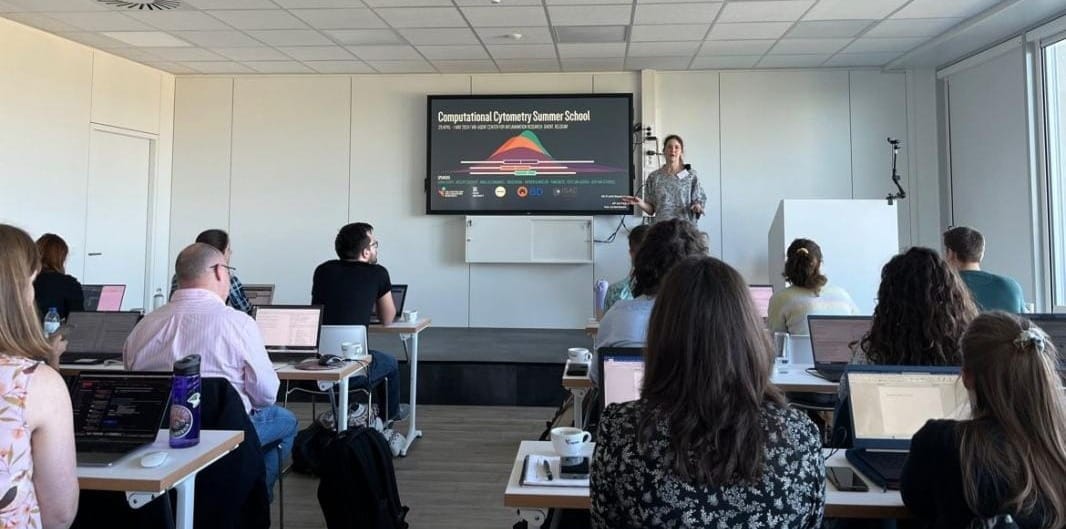
Computational cytometry tackles this data deluge with algorithmic power, operating across several interconnected domains.
First comes preprocessing and quality control. "In manual gating, you do a lot of that subconsciously, but if you replace that by an unsupervised setup, you need to make sure that quality control is in place," Sofie notes. The Saeys lab has contributed several tools to aid this process, from PeacoQC, which monitors signal stability over time, to CytoNorm, which reduces batch effects between experiments. These are essential steps before further downstream analysis because as the saying goes: garbage in, garbage out.
Another part is analysis itself: clustering algorithms and dimensionality reduction techniques can navigate 50-dimensional space in ways human intuition cannot. Sofie's best-known contribution is FlowSOM, a clustering algorithm using self-organizing maps that has become a global standard. "The clustering kind of replaces the gating because you look for cells with a very similar marker pattern that you want to group together. Rather than doing that by hand, you ask the computer: 'Which patterns do you see in the data and which events can be grouped together?'"
Finally, these analytical approaches enable predictive modeling. Once clustering identifies distinct cell populations across samples, statistical modeling can link those populations to disease states, treatment responses, or other clinical outcomes, transforming descriptive cytometry into diagnostic and prognostic applications.
Bringing new expertise to the Flow Core
Sofie's transition to the computational cytometry expert role at the VIB Flow Core represents a recognition of how critical computational expertise has become. Previously, the core focused on instrument operation and panel design, with users receiving data files and handling analysis (mostly) independently.
"We notice that people get a bit lost," Sofie explains, mentioning an immediate meeting scheduled with a researcher asking about UMAP dimensionality reduction: "How do I use this? How do I interpret the results?" Her role bridges this gap, providing training and dataset-specific guidance to help researchers navigate increasingly sophisticated analytical landscapes.
Learning from the algorithm architects
Co-organizing the program is Sarah Bonte, a postdoc in the Saeys group. To support the hands-on curriculum, they have recruited a wider team from the VIB Flow Core and the Center for Inflammation Research, ensuring that the instruction remains intensive and personal despite the complexity of the material.
"Even if you don't continue to do a lot of data analysis, having the conceptual understanding of how these algorithms work is very helpful," Sofie emphasizes. Understanding what happens ‘inside the box’ proves essential when commercial software produces unexpected results or when research questions require customized approaches.
Knowing what happens inside the box allows you to trace the biases that the algorithm is engaging in. Sofie cautions that without this insight, researchers might fall for the illusion of objectivity often promised by algorithmic tools. “Sometimes the selling point is, ‘Oh, it's completely unbiased.’ I'm like, okay, let's put a bit of nuance there,” she says. “The algorithms also make assumptions, it's just not ‘today I feel like the gate should be 1 millimeter more to the right...’ For the algorithms, you have more traceability.”
A practical, hands-on curriculum
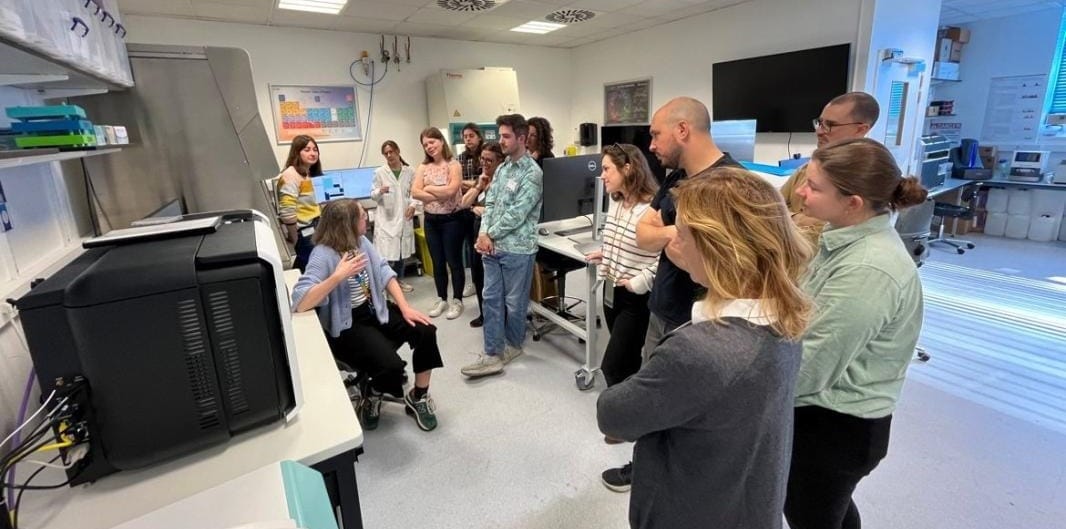
The summer school balances theory with extensive practical application. The sessions are a mix of theoretical explanation, live demonstration in R, and guided exercises with example datasets. But the program goes further, dedicating substantial time to sessions where you get to work on your own data, while having experts at hand.
"Your data never looks exactly like the example data."
"Your data never looks exactly like the example data," Sofie points out. "People suddenly notice, 'Oh, it's not just copy-paste. I need to understand what the code is doing to be able to adapt it.' We really try to cover that aspect and give as much hands-on support as possible."
For the 2026 edition, the program has been extended based on participant feedback requesting more time to absorb complex material. The teaching dataset has also been upgraded to a 20+ color panel, better reflecting the high-dimensional data participants encounter in their own research.
Because the course sits at the intersection of two fields, Sofie and the other organizers anticipate a mixed audience with complementary gaps in their knowledge. They offer targeted preparatory materials to bridge this divide in the form of online courses that can be taken before the summer school starts. Immunologists can get up to speed on syntax with an 'Intro to R,' while bioinformaticians can ground themselves in the data with an 'Intro to Cytometry'.
The week is rounded out by practical perspectives through presentations from sponsors Dotmatics, BD, and Sony. These are strategically timed after the fundamentals, ensuring participants can evaluate commercial solutions with an educated eye.
The program also includes a guest lecture from Wes Wilson, Canada Leads scientist, at the Princess Margaret Cancer Center in Toronto, who brings expertise in bioinformatics, technology development, and emerging applications like cell annotation.
“High-dimensional cytometry is only going to grow,” Sofie says. “The best thing we can do is prepare researchers to navigate it with confidence, rigor, and curiosity. That’s what this summer school is all about.”


Check for more information and how to apply. Please click the “APPLY HERE” button at the bottom of the page.