How one Belgian student helped launch Brain Bee Belgium
Meet Emmanuel, the student who helped bring the Brain Bee to Belgium
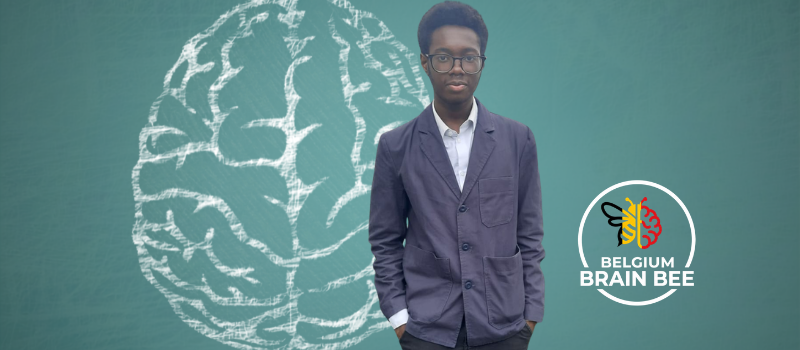
The first Belgian Brain Bee will take place this September, giving secondary school students in Belgium the chance to test their neuroscience knowledge and connect with the wider brain research community. We spoke with Emmanuel Mukanu, whose initiative helped get the project off the ground, about what motivated him, why he believes competitions like this matter, and what he hopes the Brain Bee can become in Belgium.
Where did your fascination with neuroscience originate?
"I have always been fascinated by the human mind. When I was fifteen, I read The Brain: The Story of You by David Eagleman, and that book had a big impact on me. I was especially struck by the way it explored how we perceive reality and how consciousness works."
"After that, I really immersed myself in neuroscience. Over the following year, I completed two online courses: The Neurobiology of Everyday Life from the University of Chicago, and Medical Neuroscience from Duke University. That helped me realize that this was not just a passing interest, but something I wanted to pursue more seriously."
"Looking back, I really wish I had encountered neuroscience earlier through something at school. That is why I think initiatives like the Brain Bee matter. They are not just competitions. They can help students discover a field they may never have come across otherwise. They also create a space where students can meet like-minded peers, and where they can build connections with researchers, professors, and universities. That is something I find especially valuable."
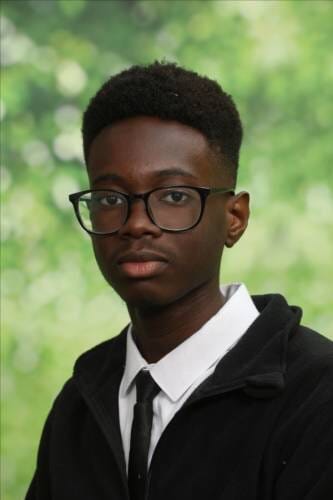
Emmanuel Mukanu Nzila
17 years old
Lives in Fleurus and goes to school at the Institut Notre-Dame de Fleurus
Loves learning languages (currently learning Turkish and Japanese, and improving his Dutch)
But you realized there was no Brain Bee in Belgium. At least not yet.
"Indeed. After competing in the Belgian Mathematics Olympiad, I started wondering whether something similar might exist for neuroscience. I quickly realized there wasn't."
"My first plan was to try and join the French Brain Bee, but that turned out not to be possible. I started researching the International Brain Bee in more detail, and eventually I decided that if Belgium didn’t have one, maybe I could help create it."
"In December 2025, I contacted the international academic coordinator to ask what would be involved in organising a Belgian competition. That was when I learned I had a choice: either participate in the competition elsewhere, or help organise one here. I chose to organise it, because it offered something broader. It meant I could contribute something meaningful to neuroscience, connect more deeply with the community, and learn a lot in the process."
"The path wasn’t completely straightforward. My initial proposal was rejected, but I reached out again to different universities and was really surprised by how many people showed interest. And now here we are: the Brain Bee Belgium is no longer just an idea, but a reality."
What excites you most about bringing the Brain Bee to Belgium?
"Honestly, what excites me most is the idea that one day Belgium could produce a winner of the International Brain Bee. I know that is ambitious, but that is exactly why it is exciting. It would be an incredible honour for the country."
"But even beyond that, it is exciting simply to know that students in Belgium now have this opportunity. In that sense, the Brain Bee feels different from many of the more traditional Belgian olympiads in science or mathematics. It creates a much more direct bridge between students and the academic world."
And for you personally, will you pursue a career in neuroscience or medicine?
"Yes, definitely. I hope to become a neuroscientist. I’m not yet certain which specific area I want to focus on, but I’m especially interested in consciousness research and in understanding how the mind works. The work of Steven Laureys, for example, is very inspiring to me. I hope to be accepted into a strong university programme later this year and to study biomedical sciences as a foundation for future work in neuroscience."
Where do you see Brain Bee Belgium going in the future?
"I hope Brain Bee Belgium will develop a strong identity of its own and become a real source of inspiration for young people in this country who are curious about the brain."
"I’m also very grateful for everyone who helped make it happen. Honestly, without the University of Antwerp, the members of the Belgian Society for Neuroscience, and VIB, this would never have been possible. Being part of the organizing team has already taught me a lot about teamwork and communication—skills I know I will carry with me into the future."
_
The Belgian Brain Bee Championship will take place in September 2026 and is open to secondary school students in Belgium. Participation is free, the competition is held in English, and the national winner will go on to represent Belgium at the International Brain Bee World Championship.
With Nerdland's Natha Kerkhofs, Peter Berx and Bart Van Peer as jury members and question masters. 🐝
All info and how to register: brainbee.be